

Printing on a different substrate is a great way to change things up. Watch this video and get inspired to create Gel prints on nonwoven fusible interfacing!
Nonwoven interfacing is a wonderful material for printing with Gelli® plates! It looks similar to dryer sheets, and its intended purpose is to add extra body to fabric. But it takes paint beautifully! And the heat-activated adhesive makes it so easy to incorporate printed pieces into your mixed media art.

The top piece in the next picture shows the adhesive (shiny) side. The piece underneath it is the ‘right’ side—the side we print on (non-shiny side). They’re placed on a black and white image to show the beautiful translucent quality of this interfacing.

The samples here are all printed on Pellon® (808 Craft-Fuse®) — but any smooth nonwoven interfacing should work well. Nonwoven interfacing comes in a variety of weights. You can buy it by the yard then cut it into pieces ready for printing.

What are the advantages of printing on nonwoven interfacing, you may be wondering?
Well… the nonwoven fiber surface prints beautifully, it’s super-easy to cut with scissors or a rotary cutter, the material is soft and easy to sew, doesn’t fray, and adds strength when fused to paper — an especially good thing when adding stitching by hand or machine on paper. Also, it has a translucent quality making it wonderful for layering over previous prints, text or images! It’s an excellent collage material for paper or fabric projects…and great for adding printed elements to painted works on canvas or board!

Begin by cutting your interfacing into pieces for printing. It makes things easy if you do this ahead of time, so you’re ready for printing. I pre-cut the interfacing used in the video into 9″x12″ pieces — perfect for printing on the large 12″x14″ Gelli® plate!

The printing process is the same as it is for paper. The one difference is that the paint on the gel plate can bleed through the back of the interfacing as you print. So I recommend using a cover sheet to keep your hands and print clean. A piece of blank newsprint paper, copy paper or deli paper works great as a cover sheet.
You’ll also find that printing on interfacing calls for heavier application of paint on your Gelli® plate.
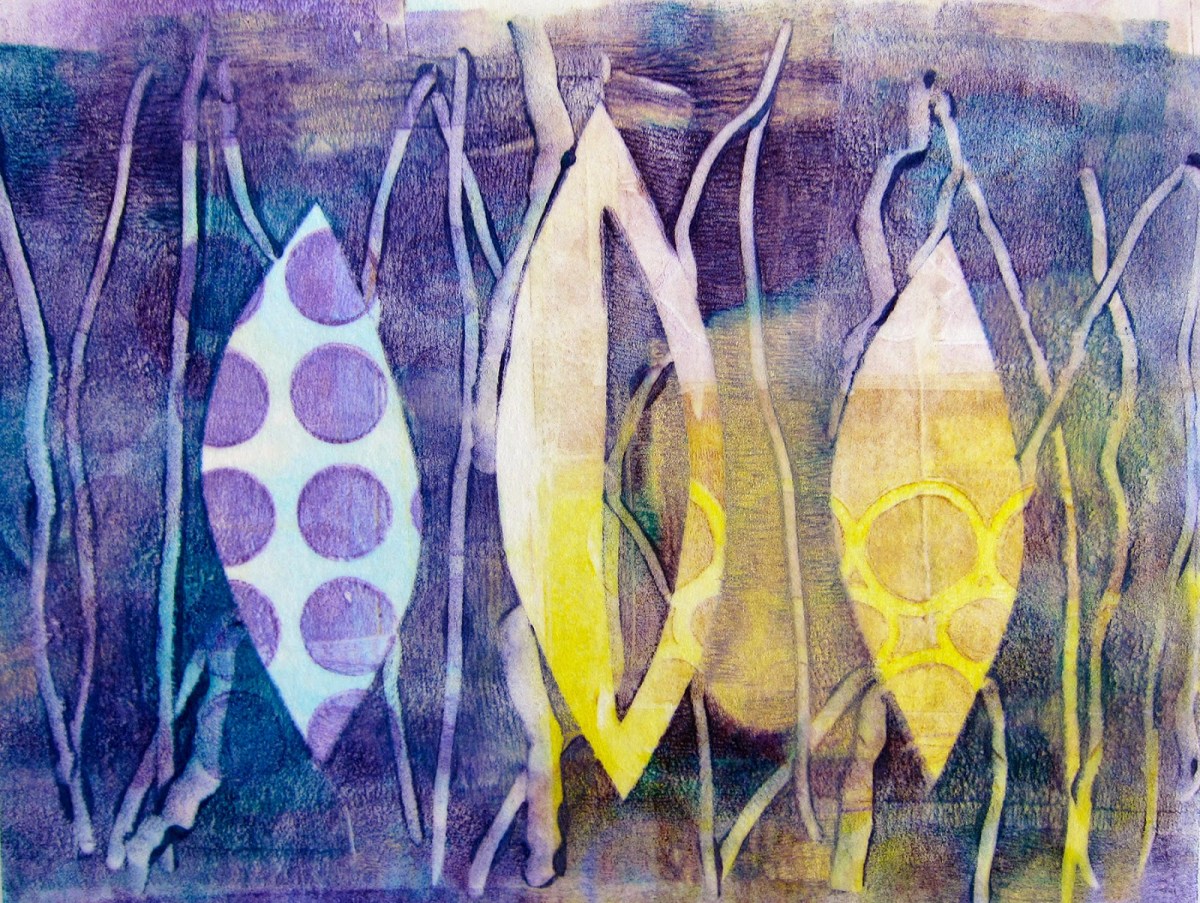
Here are the steps for printing:
- Apply paint to the Gelli® plate and roll out with a brayer.
- Make your marks in the wet paint.
- Place a piece of the fusible non-woven interfacing on the plate with the shiny side UP.
- Place a cover sheet over the interfacing and rub with your hands to transfer the paint.
- Remove the cover sheet, then pull your print!
- If there’s enough paint remaining on the plate, pull a ghost print.

You can print on interfacing in layers, just as you do on paper. Use your favorite stencils, masks, combs and other texture tools. Or if you prefer, take a painterly approach.

Once you’ve created prints on fusible non-woven interfacing you have many options for using them. The prints are perfect for paper or fabric collage, so consider cutting them into pieces and fusing to other artworks. If you have a die-cutting machine…you might try cutting them into different shapes!

If you’re looking for a good substrate to fuse your prints to… how about those papers you use to roll off paint from your brayer. They’re perfect for collage! Cut up some interfacing prints and fuse some pieces right onto the painted papers for a quick and gratifying mixed media experience! Add stitching! Add doodling! Add embellishments! Fun!

Colored pencils, NeoColorII crayons, Inktense pencils and fabric pens are among the fun ways to work further on nonwoven interfacing prints!

To fuse the interfacing to paper or fabric, follow the manufacturer’s directions. Place parchment paper on your ironing surface to protect it, then place the substrate and fusible pieces on it. Cover the whole thing with parchment paper to protect your iron. Press to fuse. Easy!
If your interfacing isn’t fusible — no problem. After you make your prints you can easily iron a layer of fusible (such as Wunder-Under or Misty Fuse — or your favorite fusible webbing) to your interfacing prints and they’re ready to fuse to another substrate. Or, simply use gel medium or your favorite collage adhesive.

Printing on non-woven interfacing is a process that can send you into a creative frenzy! So many possibilities!

FYI— Materials used in the video include the following:
- 12″x14″ Gelli® plate
- 4″ Speedball soft rubber brayer
- Fusible Nonwoven Interfacing — Pellon® 808 Craft-Fuse®
- Liquitex Basics Acrylic paint
- Amsterdam Standard Series Acrylic paint
- Hand-cut masks from blank stencil material (blue plastic)
- Hand-cut masks cut from cardstock
- Commercial stencils
- Catalyst Wedge
- Colour Shaper
- Deli paper (used for cover sheets)
This Contest is officially CLOSED
Congratulations to our winner via random number generator: DIANE!! Simply stated… we have AMAZING fans. I’m always shocked and humbled by the talent and creativity amongst our fans and contest entrants! Here is a description of Diane… A fiber artist specializing in art quilts. She loves to play with different fabrics and fibers, dyes and paints, and other surface design materials/techniques. Please – go check her blog to admire her lovely works of art!http://dianehamburgart.blogspot.com/
And we have an AWESOME GIVEAWAY!!!
Our giveaway includes a 12″x14″ Gelli Arts® Gel Printing Plate… and a special Gelli® apron!

One winner will be selected at random to receive this fabulous prize. To enter to win simply leave a comment here on the blog. Comments will be accepted until (Tuesday, July 29th at 12noon EST). Our lucky winner will be announced here on the blog and on our Facebook page no later than (Tuesday, July 29th at 5 pm EST). Good luck!
This sounds great. I can use fabric paint and add prints to quilts and other fabric items.
Another great video and its just full of ideas to use any of the Gelli plates with.
Fusing prints to paper prints: great ideas for mail art and journal covers!
How interesting! So many great ideas for uses with the wonderful Gelli Plate!
Another Gelli-great idea! Keep 'em coming! Love all the inspiration.
great idea – will be a terrific idea for totes/bags
I love these ideas! They are so pretty.
Definitely loving this idea!
What fun – and now I know what to do with that fusing I bought for another project that didn't work well…hurray!
I love this, can't wait to give it a go, thanks!
Wonderful idea!
I'm blown away.. again. Just when you think you've done it all with the Gelli. Nope. Thanks for the chance.
What an awesome effect!!
You always give great ideas love this one. Thanks
I see so many fun and exciting creations on this site! Thanx for sharing!
When I think you can't come up with another use for the Gelli, you do. Love this, can't wait to try it.
Thank you for the tip about using a tad more paint when using the interfacing, i love to experiment with fabric and interfacings and this looks like it could be quite addictive:-) xxx
What a crazy, awesome idea! Have to give this a try… 🙂
What a great idea! Tomorrow I will be pulling out my interfacing and doing some experimenting! Love your blog and all the great ideas to make sure we all get the most out of our gelli plates! Would love to own the big one – fantastic for fabric…
Oh yes, I'm definitely loving this idea! I'll be trying it very soon! Thanks for the wonderful tutorial.
I am so excited about using a Gelli plate. I have only been doing mixed media art for a few months now and just love it. I am like a sponge soaking up all I can and learning all kinds of tecniques.
What a great idea! And so many applications!
This is another great idea for adding depth to mixed media work.
Can't wait to try this
What a great idea! I will definitely try this! Thanks for the great ideas.
Great idea! I wouldn't have thought of using fusible interfacing but it's wonderful. Thank you for the video.
Ooooh! This is gonna change my fibre art!!!! thanks!
I never would have thought to try fusible interfacing. What a great idea!
Awesome! Love it.
I just love your videos and find them so creatively stimulating 🙂
What a great idea – thanks !
I love this!!! I am definitely going to try it! Thanks for all the awesome creative ideas that I myself would not be able to think of!
Great demo, thanks so much!
I love it when someone comes up with something new to make Gelli Prints on. And this might turn out to be my favorite. What gorgeous designs!!
Fabulous video I've been watching your creations with gelli plates for some time now on here and on facebook.
Looks like fun…can't wait to try it!!
Fabulous idea with excellent instructions! So many ideas to try with this technique. Thank you for this generous giveaway.
What a fabulous idea!
I was just looking at my used dryer sheets, and thinking about trying this
Thanks for the great instructions
I can't wait to try this
I am so inspired by all the ideas I have been watching here – I teach HS Art and can't wait to introduce Gelli plate printing to them
12×14 looks awesome! I have the 8×10 and the 5×7, but one day I hope to have EVERY size!!
LOVE this technique….I'm thinking a tote bag will be my 1st project. Thanks for the great tutorial!!!
Wow I love the idea of ironing directly onto a page and being able to stitch into it, what a fantastic idea, can't wait to have a go at this one.
Thanks sooooo much for the fab idea xxx
Oh and I wouldn't mind a bit if I had to find space for a 12 x 14 plate – lol
Sam xx
I just love this and need to try it!!! thanks for sharing!!!
Great idea & so many possibilities. I want to use it in quilt making and scrapbooking.
Beautiful results! I'd love to use this technique!
Oh, the possibilities; if only I weren't on my way out the door to a meeting — I'd rather be trying this out.
Love this technique, can't wait to try it, thanks!
That's pretty cool, I look forward to trying that out!