
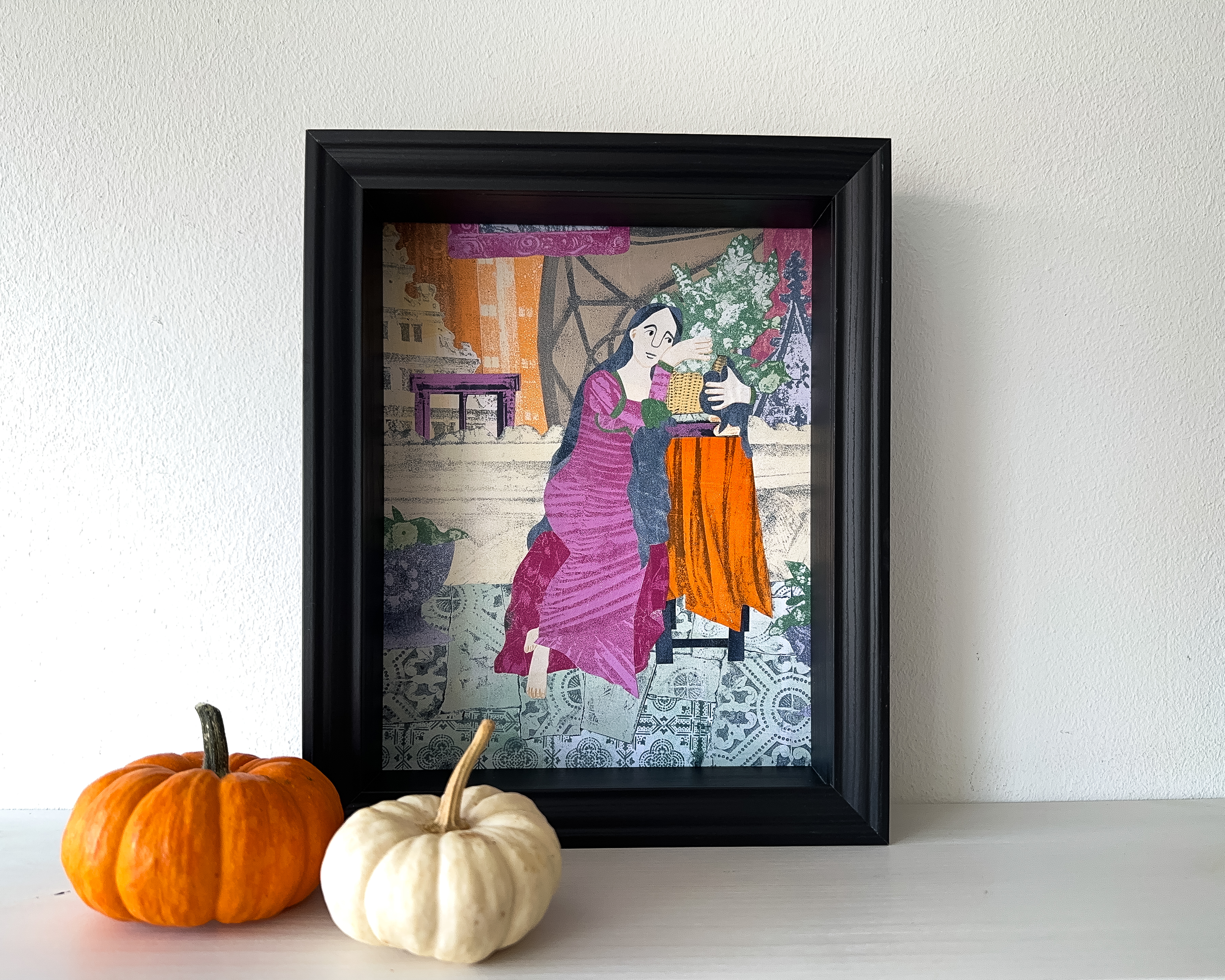

Hi there! Marsha here today, sharing a fun way to use image transfers to create collage art!
YouTube tutorial : https://youtu.be/foKP7ewCl5U
To make image transfers with the Gelli® plate, you’ll need printed matter.
You can try using pages from old books or glossy magazines. Some will work better than others, so there’s always some trial and error involved.
You’ll also have to be mindful of copyrights. When using pages from magazines or books, focus on specific elements and textures rather than entire images.

Another option is using images, laser-printed at home or at a copy shop. You can use your own photos or search for copyright-free images on, for instance, websites like unsplash.com or pexels.com.

And, Gelli Arts® now also offers a selection of Image Transfer Packs. Perfect for when you don’t have access to a laser printer!
Tips for successful image transfers:
1. Roll out a thin and even layer of acrylic paint on the gel plate.
2. Place a high-contrast laser-print (or other printed matter) on top with the image side down.
3. Gently smooth out to make sure all of the paper is in contact with the plate.
4. Pull up the paper.

5. If you’re quick, you can try pulling the print right away. Or you can leave the paint to dry on the plate.How long it takes for the paint to dry depends on the climate in your room. It usually takes one to two minutes. If you find it takes longer, you can use a hair dryer on the cold setting to speed up the process. Never use heat on the gel printing plate!
6. Roll on a new contrasting layer of acrylic paint.
7. Place your paper on top of the wet paint and rub well.
8. Wait until the paper and paint are fully dry before you pull up the paper. Paint and paper are dry when the paper no longer feels cold or damp to the touch.
9. Pull your image transfer gel print!

Tips for image transfer gel printing with collage in mind:
1. Prepare a sketch and think about what kinds of colours and textures you’ll need for your collage.
For instance, you could focus on fabric textures, flowers, foliage and trees, architectural elements or different patterns.
I based my collage on a sketch I made during a Draw Brighton Life Drawing Session with model Frankie, themed ‘Isabella & the Pot of Basil’ (www.draw-brighton.co.uk).

2. Draw (or trace) this sketch onto tracing paper. This way, you can use the sketch as a guide for cutting your collage pieces.
Sandwich your gel printed collage paper between a softer (watercolour) paper and your sketch on tracing paper.
Because the tracing paper is translucent, you’ll be able to see exactly where to place the collage paper.
Use a hard pencil to trace parts of the sketch onto your gel printed paper. The hard pencil will leave indents in the paper that you can use to cut along.
The softer paper underneath will protect your work surface and can act as a ‘cushion’.
Of course, you could also use carbon paper instead!
3. Additionally, you can trace your sketch onto a transparency with a permanent marker or pen. This transparency can serve as a rough guide to help arrange the collage pieces.
For easy alignment, ensure that your substrate, sketch, and transparency are all cut to the same size.
4. Always think before you glue.
Once you commit to glueing down collage elements, it will be much harder to correct without damaging parts of what you might already have. And sometimes you’ll still want the ability to tuck pieces behind others!
5. Take your time.
Collage is a long process. At least it is for me. It’s about slowing down, pondering, and improvising. It’s a puzzle you’ll need to solve.
6. Optional: Finish your collage by adding a few details with coloured pencil.

Happy image transfer gel printing! -Marsha.

Materials:
Other:
Glossy magazine pages
Old book pages
Acrylic paint
4″ soft rubber brayer
Copy paper (or other thin paper suitable for collage)
Tracing paper
Hard graphite pencil
Transparency
Permanent pen or marker
Watercolour paper
Glue stick
Optional:
Washi tape
Coloured pencils
Carbon paper


FIND US:
FOLLOW US:
Sign up to receive emails + special offers from Gelli Arts®